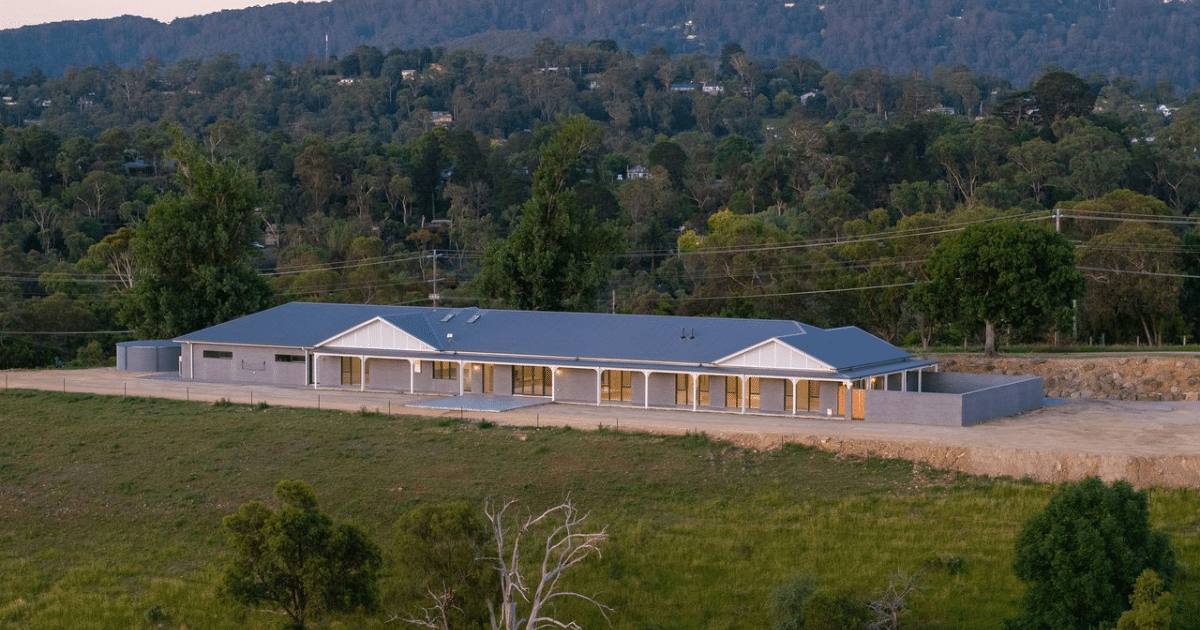
Buying land to build a house in the Yarra Valley gives you the chance to build a home shaped by the landscape, rather than fitted into a standard subdivision block.
The slope, the vegetation, the bushfire exposure and the title itself all play a part in what you can actually build there.
However, one of the most common mistakes buyers make is assuming that if a block is for sale, it’s ready to build on.
It isn’t always that simple. A block can look perfect but can still carry restrictions that only surface once a builder or designer looks closely, often after an offer has already gone in.
So before signing anything, here’s what you should check before buying a block in the Yarra Valley.
Zoning and Planning Overlays
Every property sits within a planning zone. Most rural and semi-rural blocks in the Yarra Ranges also carry one or more overlays on top of that zone, commonly for bushfire, vegetation or environmental significance.
An overlay doesn’t necessarily stop you from building. It usually means you need extra steps and extra time in the planning permit process.
Before buying, check the property’s zoning and overlays and understand how they could affect the location of your home, driveway, vegetation removal and other structures.
Don’t assume a block is uncomplicated to build on because neighbouring properties have homes. These controls can significantly affect what you can do with the land.
Bushfire Risk and BAL Ratings
Much of the Yarra Valley sits within mapped bushfire-prone areas. That means a block will usually carry a Bushfire Attack Level, or BAL rating, which affects construction requirements such as materials, glazing and clearances around the home.
This rating can vary significantly even between neighbouring blocks depending on factors including:
- The type and density of nearby vegetation
- The slope of the land
- The distance between the proposed home and vegetation
- The surrounding topography
We’ve built across a wide range of BAL ratings throughout the region. For instance, our Silvan project and our Kalorama project both carry a BAL 29 rating, while our Ferny Creek build sits at BAL 12.5, on blocks that aren’t far apart as the crow flies.
That spread is the point. You can’t assume a rating from the suburb alone. It needs to be checked on the specific block, since what a BAL rating actually means for design and construction can vary just as sharply.
Rather than treating a bushfire rating as a red flag, it’s better understood as one more input into the design and an experienced regional builder should factor this in from the earliest conversations.

Slope, Orientation and Access
A sloping block changes almost everything about a build. The foundation type, how the house sits on the land, and what a driveway needs to do to reach it safely all come back to the block’s slope.
Orientation matters too. A north-facing slope behaves very differently from a south-facing one, in terms of light, warmth, and how usable the outdoor areas end up being.
None of this makes a sloping block a poor choice. Some of our most distinctive Yarra Valley homes exist specifically because of what the slope allowed.
That’s also why a site assessment with a builder can help you identify these issues early.
Vegetation and Tree Cover
Established trees are part of what makes many Yarra Valley blocks so appealing. They’re also one of the more commonly misunderstood restrictions.
Native vegetation on a property, and sometimes vegetation on neighbouring or roadside land, can restrict what can be cleared and where a home can be sited. A block that appears to have plenty of usable space may have far less once vegetation requirements are taken into account.
Before you buy, find out which trees can be removed, whether permits are required and how vegetation constraints could affect the proposed building area, driveway and services.
Start Planning Your Dream Home
Thinking about building a custom home? Our team can guide you through design, planning, and construction.
Services: Power, Water and Wastewater
Rural and semi-rural blocks don’t always come connected the way suburban blocks do.
Power may need to be extended to the site. Water may rely on tank storage rather than mains. Wastewater on an unsewered block requires its own assessment of what the land can support.
None of this needs to be a deal breaker. You just have to check it before you buy, because it shapes both the build process and where things sit on the block once you start designing.

Title Restrictions: Easements and Covenants
Beyond zoning, the title itself can carry conditions that affect where a house can be built.
An easement might give another party, such as a utility provider, rights over part of the land. A covenant might restrict building materials, minimum floor area or even how many dwellings the title allows.
These are easy to miss in a standard property search and can genuinely redraw where a home ends up on a block.
Why Local Knowledge Matters Before You Buy, Not Just Before You Build
Every one of the checks above is easier to get right with someone who already knows the Yarra Valley than with someone learning the region for your project.
Our team at Cobalt Constructions has built on sloping sites, with varying BAL ratings and on rural blocks with their own service and vegetation constraints throughout Wandin, Silvan, Olinda, Kalorama, Mount Evelyn and beyond.
The pattern holds everywhere. The block decides more than most buyers expect.
If you’re looking to buy a block in the Yarra Valley, it’s worth having that conversation before you make an offer.
Start Planning Your Dream Home
Thinking about building a custom home? Our team can guide you through design, planning, and construction.
Frequently Asked Questions
Do I need a planning permit before I can build on my Yarra Valley block?
In most cases, yes. Whether it’s straightforward depends less on the zoning itself and more on whether an overlay, commonly bushfire, vegetation or landscape, sits over the block. Overlays often mean extra reports and sometimes a referral to an outside authority, which usually stretches out the timeline.
How do I find out my block’s BAL rating?
You’ll need a site-specific Bushfire Attack Level assessment, carried out by a qualified assessor who looks at vegetation type, slope and distance to that vegetation. Every block is different, even within the same street, so it always needs its own assessment rather than a guess based on a neighbour.
Can I remove trees on my own property before building?
Not necessarily. Native vegetation controls apply regardless of who owns the land, depending on the type and extent of vegetation and any overlay on the title. A bushfire exemption allows some clearing around an existing dwelling, but not a new building envelope on vacant land.
What’s the difference between an easement and a covenant?
An easement is a right someone else holds over part of your land, most often for drainage, sewerage or access, tied to a defined strip of the block. A covenant is a private condition on the title itself that can restrict dwelling numbers, materials or size across the whole property.
Should I get advice before buying land to build a house?
Yes, where possible. A title search, a planning report and a site walk with a builder are far easier to arrange before an offer than after one. Once a purchase settles, a design has to work around whatever restrictions exist rather than being planned around them from the start.